
INDEX Team at the Symposium "The Most Documented War: Polyphony of Stories"
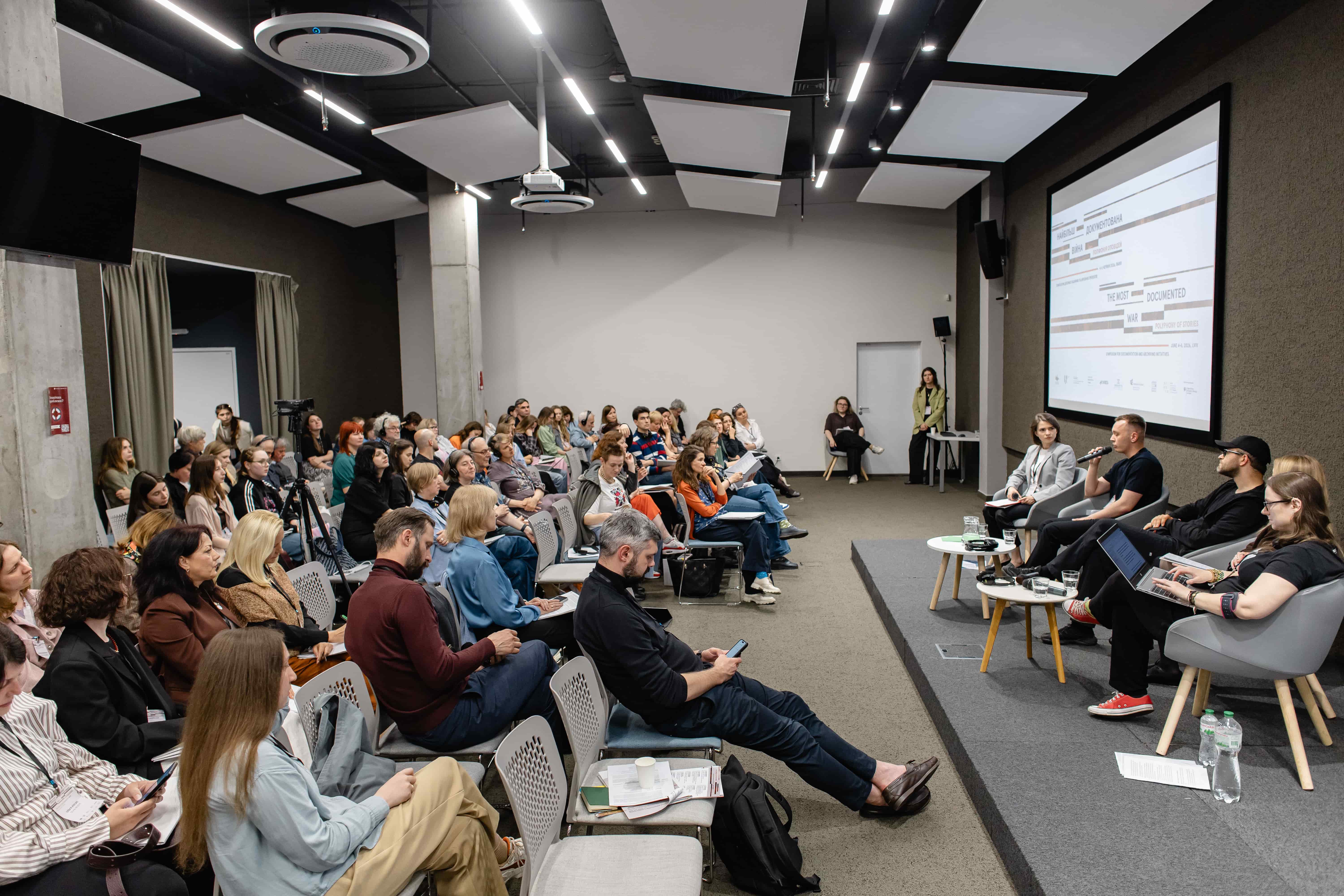
Photo: Bohdan Yemets
A three-day symposium on documentary and archival projects, entitled “The Most Documented War: A Polyphony of Narratives”, took place in Lviv from 4 to 6 June. This fourth annual three-day event provided an opportunity for Ukrainian and international experts to discuss the development and challenges of documenting Russia’s war against Ukraine. More than 50 experts took part in discussions across 10 thematic panels, including the INDEX team and its fellows.
On My Behalf: Stories of Those Who Cannot Speak for Themselves
On the first day of the symposium, Olesya Yaremchuk, INDEX programme curator, facilitated the discussion titled ‘On My Behalf: Stories of Those Who Cannot Speak for Themselves.’ The panel focused on challenges and dangers of representing the stories of deported people, fallen soldiers and civilians, residents of occupied territories, as well as animals and plants. Olesya spoke to Barbara Hunčovská, Vladyslav Yehorov, Mykhaylo Palinchak, and Iryna Stratiienko, asking them about their projects and research with a particular focus on how to prevent the retraumatisation of the interviewees. While discussing Palinchak’s photographic project ‘Occupation Diaries,’ Olesya mentioned the upcoming release of the book Yahidne. Diary from the Basement by Olha Menyailo, which she compiled and edited.
Storytelling as a Domain of Justice
The head of INDEX, Sasha Dovzhyk, moderated a panel titled ‘Storytelling as a Domain of Justice,’ which focused on historical and contemporary narratives about war crimes and contaminated lands, considering to what extent these shape the conditions for a just peace. Opening the panel, she quoted Ioulia Shukan, INDEX and Center for Urban History 2025 Fellow:
I'm inspired to re-appropriate the excellent term that Ioulia Shukan is using in relation to amputations: biographical break. Because, probably, war is also a biographical break for individuals and for societies. And here we are asking ourselves whether this break can release any transformative energy at all, or can it also be described as what Julia has called double punishment?
Sasha Dovzhyk
Among the speakers at the panel (Dmytro Afanasiev, Stephen Naron, and Denys Sultanhaliiev) was a soon-to-be Fellow at INDEX, Nina Direnko, who is joining us this July for the inaugural Environmental Humanities Fellowship programme. Nina shared with the audience parts of her fascinating research on Babyn Yar, and how she works with historical materials about the nascent movement of nature protection in Ukraine in the early XX century. She also discussed the methodology of research on nature and voiced hopes about its future:
…I imagine that in another 111 years, I very much hope there will be some enthusiasts who will want to revisit those very same places in Kyiv, and that they will still exist, and that various organisms will be living there; that the researches will notice even more, but will do the same thing—name and classify these organisms, trying to discover something new.
Nina Direnko
Place / Roots: In Search of Home
Our current Victoria Amelina Fellow, Anna Gruver, was one of the invited speakers at the panel “Place / Roots: In Search of Home” (along with Viktoriia Grivina, Kateryna Iakovlenko, and Charlotte Higgins; mod. by Ostap Slyvynsky). During the panel, Anna reflected on her personal understanding of ‘home,’ how it comes through in writing, and how our perception of time shifts in the fifth year of the full-scale invasion. Anna’s thinking was largely informed by the experience of writing her first novel, Her Empty Places (2022), and she elaborated on the idea of a special relationship between the sense of home and emptiness:
…It seems to me that we are now beginning to get a sense of home – at least in my case – precisely because of homelessness, because of the emptiness, because of what is no longer there, because of what has been lost, surely, for most of us, forever. However much we might want to lull ourselves with the possibility of a return; but we must realise that we will never return to that very place, to those very selves.
Anna Gruver
Kateryna Iakovlenko, INDEX 2025 Victoria Amelina Fellow, contributed to the discussion by retelling a personal story of migration from Donbas and displacement after the destruction of her apartment in 2022. These experiences as well as a return to the site of her destroyed home prompted her to ponder about the connections between real estate, their ruins, and individual immobility. Kateryn thus conceived of different dimensions of home, and also brought up an issue of potential retraumatisation:
…I was thinking a lot in 2022, because when you’re physically unable to reclaim your destroyed home, but you see a whole bunch of photos online of various people posing in front of their private houses, you find yourself wondering just how intriguing the word ‘property’ is, and ‘ruins’, and who now owns your personal ruin… how easily your personal trauma can be appropriated by someone else who’s trying to talk about it for some other reason.
Kateryna Iakovlenko
The INDEX team is grateful to all the co-organisers of this year’s symposium for another round of productive discussions and conversations. Follow our social media accounts for more information and video materials from the event.